
The Narrative Coherence Crisis in Luxury: A Comparative Case Study of Louis Vuitton, Hermès, and Miu Miu
FSW examines how rising content volume and declining narrative coherence are creating structural commercial risk across luxury through a comparative case study of three major brands.



Luxury content has never been louder. Content calendars are full; campaigns are nonstop; and new formats and trends arrive faster than most brands can absorb them.
Yet, beneath this superficial abundance, full of splashy runway shows, celebrity campaigns, and expensive creative ads, something more troubling is happening.
In our January 2026 It’s A Working Title (IWT) Content Effectiveness Index (CEI), which assessed 24 global luxury brands, we found that as content output continues to rise, narrative coherence quietly deteriorates. Similarly, in our cross-sectoral quantification of content quality across 13 different industries released last week, we found that luxury ranked near the bottom. Luxury brands are producing more content, but meaning is fragmenting, if you will. Content—and, in turn, brand identity—feels like a sea of sameness and is fragmenting. And that fragmentation carries real commercial risk.
Louis Vuitton’s latest results make that risk visible.
Long regarded as the bellwether of global luxury, Louis Vuitton now offers a clear entry point into a broader comparative analysis of how narrative systems perform at scale. The brand’s recent performance does not simply reflect cyclical market pressures or shifting consumer sentiment. It exposes what happens when creative ambition expands faster than the narrative structures designed to support it. In this sense, Louis Vuitton functions less as an outlier than as a diagnostic case, making visible vulnerabilities that exist, to varying degrees, across the luxury sector as a whole.
Considered alongside the performance of brands such as Hermès and Miu Miu, both of which demonstrate strong narrative coherence in spite of very different creative expressions, Louis Vuitton’s results offer a useful frame for the commercial stakes of narrative design. Where narrative systems are clear, disciplined, and operationalised, brands retain meaning as they scale. Where they are diffuse or implicit, value begins to leak.
The LVMH full-year results provide the financial context for this comparison.
LVMH Full-Year 2025 Revenues
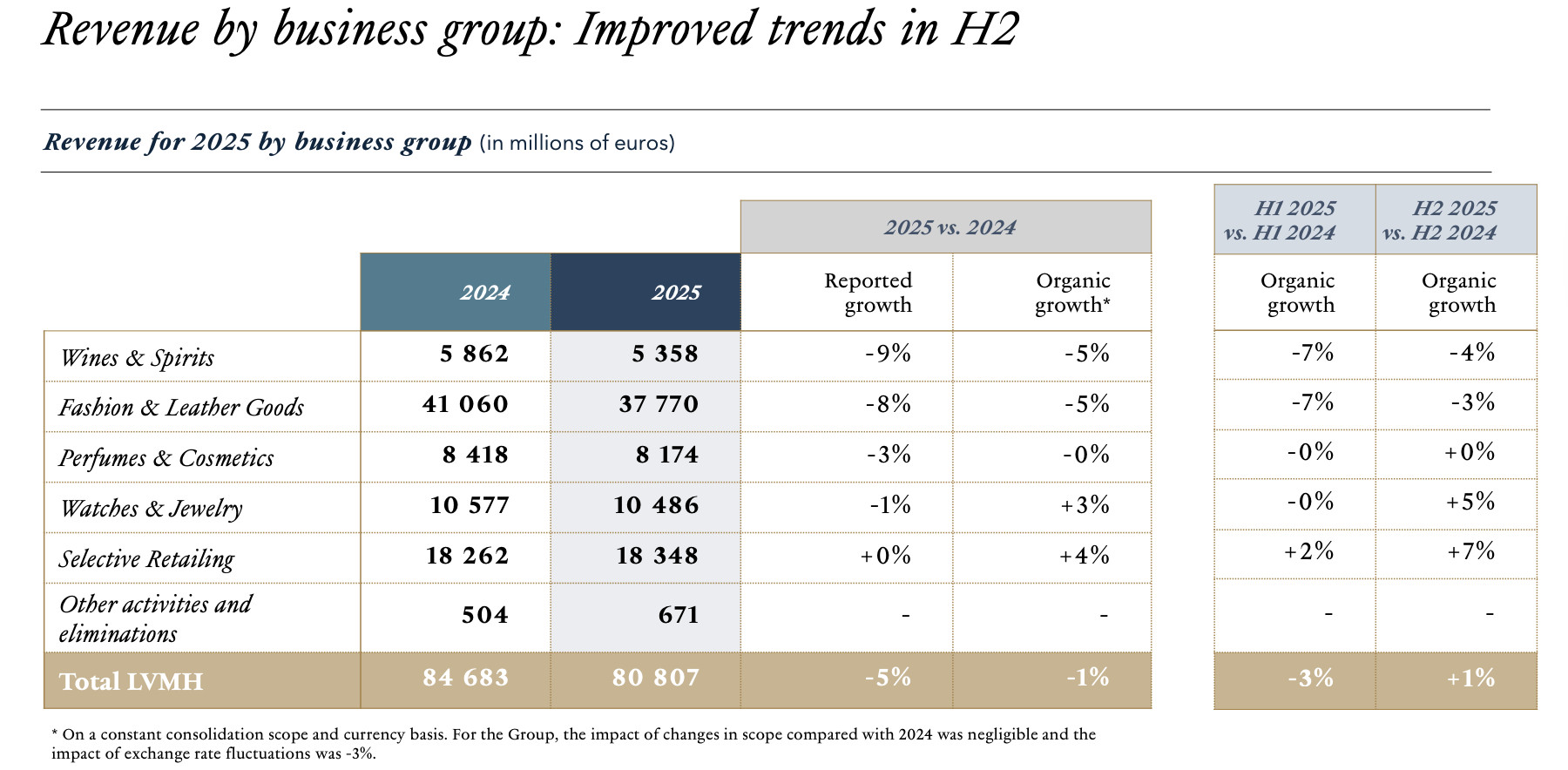
Based on the 2025 LVMH annual report, Louis Vuitton reported a 13% fall in net profit to €10.9 billion and a 5% decline in total sales to €80.8 billion. The most significant contractions in sales occurred in its Fashion & Leather Goods (-8%) and Wines & Spirits (-9%) divisions, categories integral to its market identity. These numbers reflect more than temporary macroeconomic headwinds; they are the result of persistent structural deficiencies in content and narrative systems, as formalised in their CEI brand score of 5. As we discuss below, brands with strong narrative systems reported positive and, in some cases, very strong sales growth last year.
The Latest IWT Content Effectiveness Index Results
Content coherence, as measured by the CEI, is not determined by production scale or creative novelty but rather by a brand’s capacity to maintain stable, recognisable, and unique narratives across all consumer touchpoints. Our latest IWT CEI white paper identifies three principal dimensions, which result in a total index score ranging from 3 to 9.
Shoppability: The directness with which content translates brand aspiration into consumer action.
Narrative Consistency: The discipline with which brand codes and storylines are maintained across platforms, channels, and campaigns.
Targeting Precision: The rigour with which content addresses and aligns with defined audience strategies.
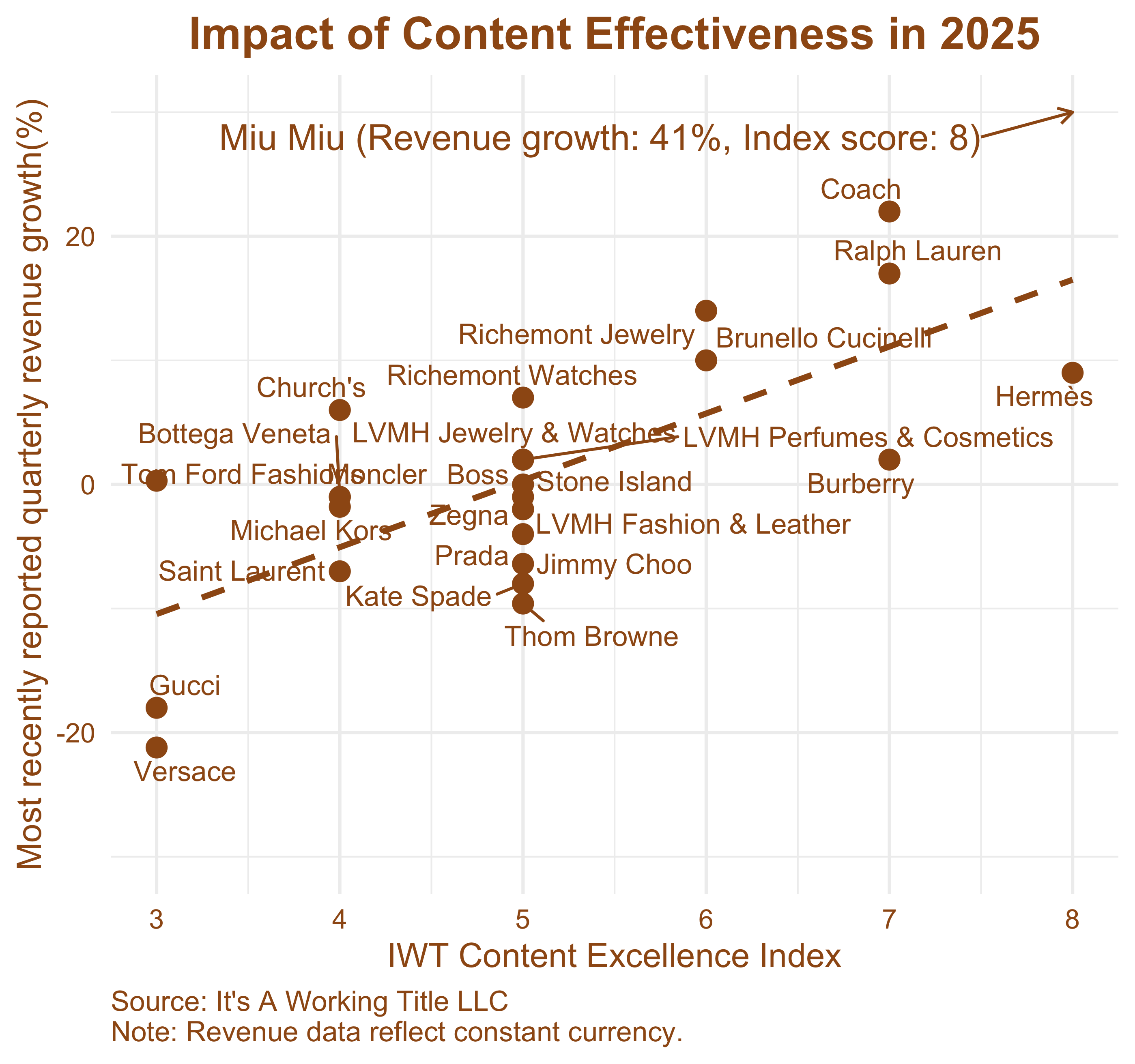
The most recent CEI results, presented in the scatterplot below, reinforce the trend towards pronounced differentiation between brands, rather than industry-wide progress. Only five brands achieved scores above 7: Miu Miu (8), Hermès (7), Coach (7), Burberry (7), and Ralph Lauren (7). These leaders operate from advanced, systematised narrative frameworks, not only excelling creatively but embedding coherence operationally at scale. As the positive correlation between our index and sales growth implies, consumers have rewarded these brands.
The middle tier—the likes of Brunello Cucinelli (6), Prada (5), and Zegna (5)—shares heritage strength but faces systemic problems. For these brands, while campaign assets remain compelling for the most part and some of them demonstrate active investment in innovation, improved digital CX, and better storytelling on the surface, e-commerce, retail store environments, and clienteling tools tell a different story, frequently conveying inconsistent or diluted brand narratives. The consequence is clear: an absence of strategic integration erodes content shoppability and audience clarity.
Louis Vuitton’s placement at the lower end, with a CEI score of 5, underscores the luxury sector’s core vulnerability. The brand’s substantial investment in creative assets across a myriad of channels—e-commerce, mobile, social, gaming, IRL, immersive, etc—is undermined by the lack of a unifying, modular narrative architecture. In short, they are telling a lot of stories but lack the narrative definition, consistency, and audience attenuation of their competitor brands. In this way, the recent financial decline of Louis Vuitton is not a cyclical anomaly; but rather it is an indicator of operational and narrative structural misalignment with commercial consequences.
Case Study: The Hermès Storytelling Model
Among luxury leaders, Hermès shows that narrative coherence, rather than campaign velocity, content volume, or channel diversity, is what sustains both brand equity and commercial resilience. Its work with emerging animators is a perfect example. Their Instagram is full of playful, visually inventive films that feel light and contemporary, yet always identifiably expressive of core Hermès brand codes. The aesthetic is fun without being noisy, expressive without spectacle. Here, animation, as a form of dynamic content, is being used as an expressive art form rather than just a trend vehicle.
Across touchpoints, from social shorts and product storytelling to flagship retail and experiential moments, Hermès quietly reasserts the same principles with rigor and discipline: the horse as a playful symbol of movement and history, leather as a living artefact of brand heritage, the artisan as craftsman and creative visionary, time measured in generations rather than seasons, and design that evolves through refinement, not disruption.
This narrative consistency is far from not accidental. Hermès’ content strategy is a perfect case study of brand strategy in action: clear narrative principles are reinforced by operational guardrails designed for scale. As the brand expands into new categories or markets, its narrative core stays fully intact and instantly recognisable, allowing experimentation at the surface while preventing dilution.
Structural Causes of Narrative Inconsistency
Our recent white paper identified three common characteristics or traits among lower-performing brands:
Operational Silos: Teams responsible for digital, retail, clienteling, and campaign assets produce work in functional isolation, in the absence of a unified, systematised narrative template. The result is channel-specific performance without overarching brand meaning.
Tactical Reactivity: Brands adapt too quickly to short-lived cultural moments and algorithmic shifts, which undermines narrative discipline and strategic longevity. Content is effective in the short term but destructive to long-term brand equity.
AI-Led Proliferation Without Systems: Rapid content scaling through AI tools, in the absence of robust narrative architecture, compounds inconsistency and deepens structural deficiencies. It also weakens brand positioning when AI outputs feel inconsistent or incongruous with brand codes, such as the recent negative reaction to Valentino’s rampant use of AI for its DeVain Digital Creative Project.
The Miu Miu Distinction: Coherence and Cultural Agility
For the luxury industry as a whole, Miu Miu’s sector-leading CEI score of 8 is instructive. The brand consistently demonstrates narrative discipline, cultural responsiveness, and deep audience awareness and shifts appropriately with the season and cultural moment. Miu Miu’s approach is not to impose rigid aesthetic codes, but rather to use an adaptive narrative framework—or the proxy of one through highly controlled brand strategy and content marketing—that maintains relevance across channels while staying true to its core brand identity.
Strategic Takeaways for Luxury Chief Marketing Officers
A CEI score at or below 5 does not point to a content problem in isolation. It signals that a brand’s narrative is fragmenting as it scales, and, in turn, that content investment may be starting to dilute, rather than compound, value.
For brands, the solution is not more content, faster output, or bigger budgets. It is the intentional design of narrative systems: shared principles, structures, and decision frameworks that allow creativity to scale without sacrificing meaning, consistency, or emotional clarity. When brand storytelling is designed rather than improvised, it functions as corporate strategy and risk management, protecting brand equity while enabling sustainable growth.
For global luxury brands operating at scale, narrative design is no longer a “soft” discipline. It is foundational infrastructure: the mechanism that ensures what a brand stands for remains legible, differentiated, and durable as markets, platforms, audiences, and expectations continue to evolve and shift over time.