
Substance and Spectacle: A Structured Case Study of Burberry and Gucci
FSW examines the state of storytelling at Burberry and Gucci and explores what they reveal about luxury’s real narrative disconnect.


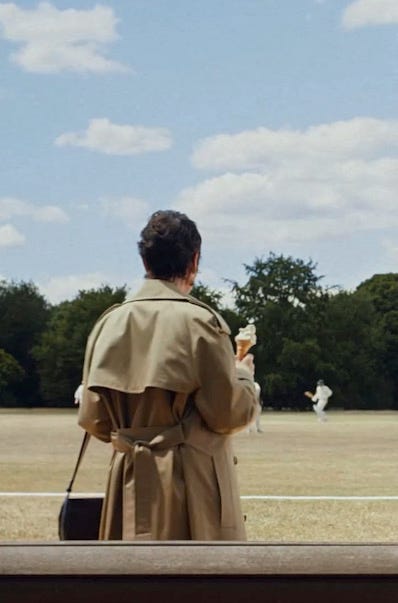
Luxury excels at spectacle. From collaborations tied to the Winter Olympics in Milan to Louis Vuitton’s partnership with Formula 1, luxury brands are expanding into new categories, launching beach clubs and remote travel activations, jumping onto viral social trends, and investing in micro-culture and long-form content in an effort to drive engagement. Yet many of these initiatives fall short on the narrative substance and cross-channel consistency required for true brand differentiation and enduring brand meaning. As campaigns and activations multiply, the connective tissue that should unite them into a coherent whole becomes increasingly fragmented.
As our recent white paper, The Differentiation Economy: Why Narrative Systems Will Define Growth in the AI Era, explores, the problem with luxury content today is not a lack of storytelling or creative expression across visual merchandising, digital marketing, product design, or runway presentations. It is a palpable lack of narrative cohesion and differentiation across channels. Narrative cohesion is central to luxury brand storytelling, which attracts consumers and drives long-term value. Brands that offer good, cohesive stories win with consumers.
Strong storytelling on one platform—Instagram, TikTok, a fashion film, or a runway moment—often masks a deeper disconnect between brands and consumers. That disconnect typically reflects internal fragmentation within the brand’s own content ecosystem: siloed teams, separate creative budgets, minimal collaboration, competing priorities, and poorly documented rules for how content is developed and sustained over time. The result is not a lack of content, but a state of luxury content pandemonium.
This raises an important question: how can luxury storytelling feel so disconnected at a moment when brands are becoming media empires and their agency partners pioneers of transmedia marketing?
A surprisingly sharp answer comes from the 1961 film Lover Come Back, featuring Rock Hudson and Doris Day as creative leads at rival ad agencies. In the film, Hudson inadvertently launches a saturation marketing campaign for a product called “VIP”. The problem is that “VIP” doesn’t exist. Billboards, television spots, and print ads flood the market with generic but compelling messages (“Everything I have is because of VIP”) and the campaign goes the modern equivalent of viral. Only later does Hudson scramble to invent the product itself, which results a highly alcoholic chocolate candy that sends Madison Avenue into a frenzy.
The satire in Lover Come Back works because it exposes a truth that still holds today: distribution, amplification, and creative spectacle can temporarily mask the absence of substance. The problem is not that advertising is powerful; it is that advertising without an underlying narrative reality eventually collapses under its own weight. What looks like success is often just momentum without meaning.
Many luxury brands now find themselves in a similar position—producing high-impact, pseudo-narrative content that leans heavily on celebrities, influencers, and trends, but says little about a distinctive point of view. Like “VIP”, the spectacle often precedes the substance. The result is content that feels impressive in isolation yet forgettable in aggregate, trading short-term engagement for long-term brand building.
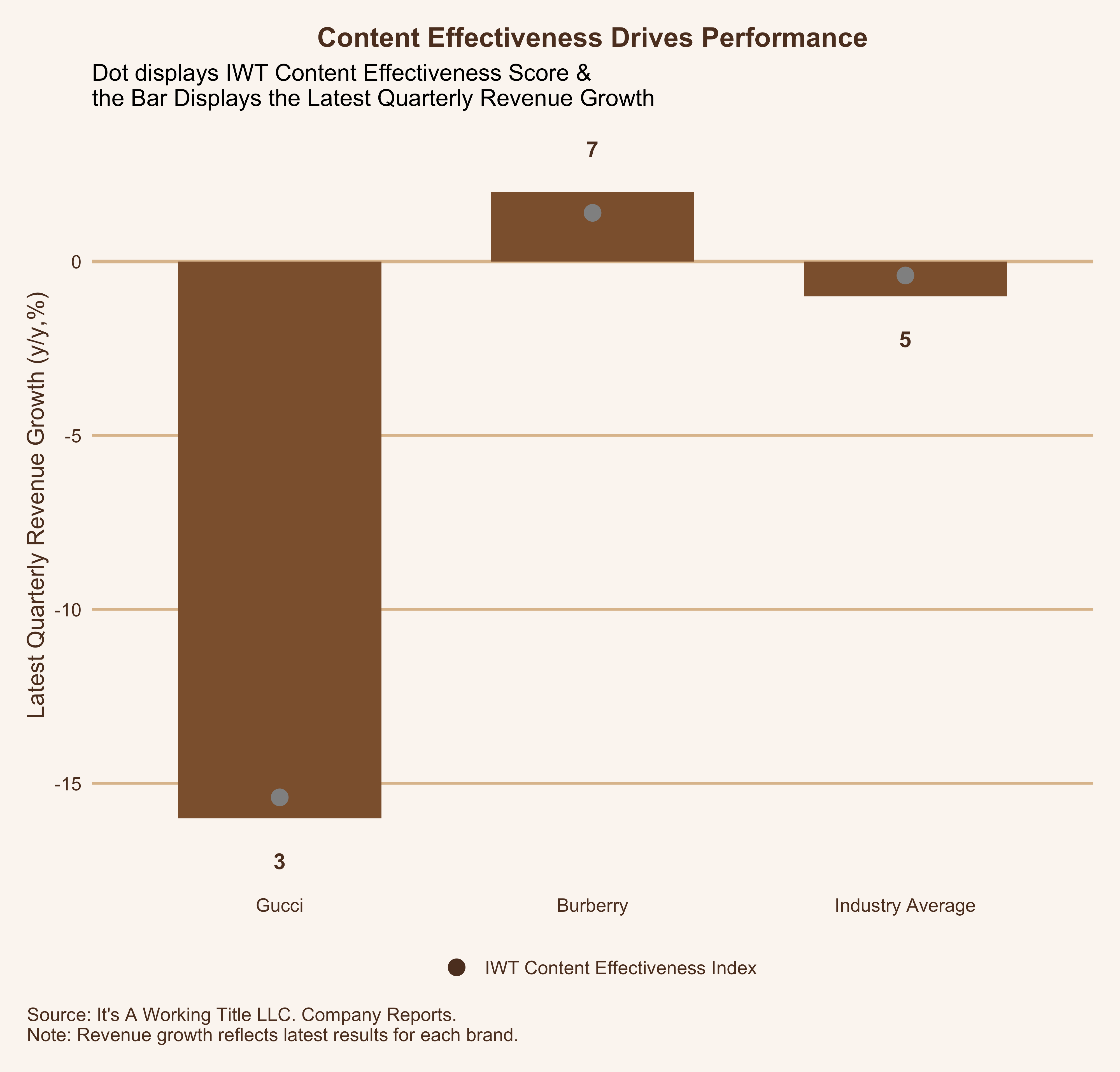
This dynamic helps explain why some brands are pulling ahead while others struggle. Why is Burberry—whose score on our IWT Content Effectiveness Index rose from a 5 in 2025 to a 7 in January 2026—regaining momentum with consumers, while a heritage house like Gucci, which scored a 3, continues to wrestle with resonance? As the case studies that follow illustrate, the difference is not creativity or investment, but the presence—or absence—of a coherent narrative system.
The brands that win with content over time are those that invest not only in brand strategy, but in narrative systems that enable teams to express a consistent, authentic, and culturally grounded worldview across channels. Crucially, these systems also create the operational clarity required to integrate technologies like AI and personalisation without amplifying fragmentation.
Burberry vs Gucci: Heritage, Value, and Narrative Cohesiveness
Lover Come Back offers a useful lens through which to analyse the current state of luxury content. At a time when brands are under pressure to operate like media companies operate across an expanding set of channels, platforms, and cultural moments, the challenge is no longer producing creative work, but ensuring that those moments accumulate into something coherent. Examining the content performance of Burberry and Gucci over the past two years make this contrast visible. Both brands deliver high-quality creative, yet only one has taken the time to re-organise its storytelling around a clear narrative axis, while the other continues to spin around and experiment in multiple directions without a unifying centre.
Burberry: Narrative Consistency Through “Burberry Forward” and Heritage-Rooted Storytelling
Over the past two years, Burberry has undergone a strategic recalibration that places narrative coherence at the centre of its content ecosystem. Under CEO Joshua Schulman’s “Burberry Forward” strategy, the brand has consciously shifted toward storytelling that connects heritage, recognisable British cultural touchpoints, and modern relevance.
Campaigns and Narrative Anchors
“It’s Always Burberry Weather” series: An ongoing campaign that reframes classic British imagery through contemporary lenses, starring British models like Nora Attal and drawing on playful tropes from everyday British life.
High Summer 2025 campaign: Evocative seasonal storytelling featuring Rosie Huntington Whiteley and Jack Draper that ties the brand’s maritime references and trench coat heritage to modern lifestyle narratives.
Celebrity-led mini films: Actors such as Olivia Colman and music icons including Liam Gallagher have anchored digital and IRL+ activations that emphasise Cool Britannia with a cultural specificity rarely sustained across luxury campaigns.
Music-inspired runway at London Fashion Week: Burberry’s Spring Summer 2026 show was explicitly tied to British music culture, from crochet and fringe detailing to a rock infused soundtrack, reinforcing a coherent aesthetic narrative across runway, editorial, and social channels.
Digital and IRL+ Integration
Rather than chasing every emerging trend, Burberry has anchored digital experimentation, from NFTs in Blankos Block Party to selective gaming activations, to its core narrative. Offline, flagship environments and window displays echo the same themes of Britishness (like the kitschy knight’s helmets that feel omnipresent in their social media), weather, and everyday luxury, rather than presenting disjointed episodic moments. The result is a disciplined ecosystem in which each touchpoint reinforces a shared worldview, marking a clear shift from the brand’s recent past.
Gucci: Abundant Creativity, Fragmented Narrative
Gucci’s investments in digital, experiential, and cultural activations are, in a word, but, from the outside, its brand ecosystem lacks a single, apparent narrative that connects one initiative to the next. For the most part, it feels like the brand is throwing creative paint at the wall to see what will stick, which is not a good way to position a brand, never mind build worlds.
Campaigns, Platforms, and Narrative Drift
Demna’s debut campaign: The first major marketing rollout under creative director Demna Gvasalia leaned into archetypes and identity cues. However, many critics noted that its metaphorical framework felt disconnected from both Gucci’s heritage and its prior creative eras.
Gucci library retail window installations: Recent flagship window displays built around a library motif were widely admired for their craft, symbolism, and visual restraint. The installations referenced knowledge, culture, and heritage in a way that felt thoughtful and elevated, yet they appeared largely as a standalone moment, with limited integration into Gucci’s broader campaign storytelling or digital narratives.
Gucci Garden on Roblox and in the metaverse: One of the earliest and most extensive (and likely expensive) luxury metaverse activations, blending exploration with heritage inspired rooms, AR digital sneakers, and collectible elements.
Web3 partnerships with SUPERPLASTIC: Fine art NFTs and character driven collaborations that expanded Gucci’s digital reach but sat wide of a core narrative centred on product or cultural positioning.
Fashion screens and digital sneakers: Initiatives such as Gucci Virtual 25 and other digital fashion drops that operate in virtual worlds but often without clear linkage to the brand’s current storytelling pillars.
Fragmentation Across Channels
Suffice to say, Gucci’s content efforts across channels, from the runway to gaming and immersive, IRL+, social media campaigns, and beyond, largely stand on their own, rather than working together to reinforce a single, cohesive story.
This artistic decentralisation, if you will, while culturally rich and at times highly successful in driving engagement, results in a constellation of content moments that rarely coalesce into a deeply differentiated narrative identity. As a consequence, Gucci’s content ecosystem often feels like many icons and few stories. That reality is reflected in its lower placement on content effectiveness measures and, in many cases, slower resonance with broader luxury audiences.
Narrative Systems vs. Moments
The difference between Burberry and Gucci does not come down to money or creativity. Both are strong in these areas. The real difference is how their content is organised and sustained over time.
Burberry’s recent campaigns and activations feel coherent because they are grounded in a clear point of view and rolled out deliberately across channels. Each moment builds on the last; and the stories all feel like they’re coming from the same brand. Gucci’s content, by contrast, is often strong in an individual moment or on a specific touchpoint, like their library store windows, but on the whole it tends to move in several directions at once, without a single organising idea pulling everything together.
What Burberry is building looks less like a collection of campaigns and more like a connected system. It works in stores, online, on social, and in newer platforms because it is designed to do so. Meanwhile, Gucci is building moments, but without enough connective structure to turn them into a sustained narrative.
Why Narrative Systems Win
Burberry’s turnaround demonstrates how narrative alignment changes the behaviour of an entire content ecosystem, as the improvement in its IWT Content Effectiveness score over the past year reveals. When strategy and storytelling are structurally connected, campaigns, social activations, and IRL+ experiences work together and reinforce one another instead of competing for attention. As AI-driven distribution and personalisation accelerate, this dynamic will become increasingly important. Systems amplify intent. Fragmentation amplifies noise.
The implication for luxury is clear. Content should no longer be treated as a series of isolated moments or micro-cultural episodes, regardless of the spin or social media attention they receive. It should function as an interconnected ecosystem whose strength depends on coherence over time. As the example of the film Lover Come Back nicely showcased, creative momentum can be manufactured, but it cannot be sustained for the long term without underlying narrative reality. Narrative brand systems that are deliberately designed, documented, and operationalised are what allow meaning to travel, compound, and endure.
(Video credits: Burberry, “It’s Always Burberry Weather”; Gucci, “La Famiglia”)
This is about content, but it made me think of Saint Laurent under Vaccarello. You can see a new system forming. The stylized logo is back, and now the slower layers (stores) are catching up too. A lot of the old marble-and-chrome, very Hedi-coded spaces are getting reworked into something warmer and more architectural. The fast stuff moves first, the slow stuff follows, but the bet on narrative cohesion feels clear.
Superb and insightful analysis as always Jessica and Bryce.