
The Differentiation Economy: Why Narrative Systems Will Define Growth in the AI Era (web edition)
FSW unveils the It's A Working Title Luxury Industry Outlook 2026 and the latest update to the IWT Content Effectiveness Index.



“I saw the hideous phantasm of a man stretched out, and then, on the working of some powerful engine, show signs of life, and stir with an uneasy, half vital motion. Frightful must it be; for supremely frightful would be the effect of any human endeavour to mock the stupendous mechanism of the Creator of the world.”
Mary Shelley, “Frankenstein” Chapter 4 (1818 ed.) or Chapter 5 (1831 ed.)
This is the third annual luxury industry Year Ahead report produced by the research team at It’s A Working Title LLC. Like its two predecessors, this report aims to look around the corner at trends that we believe will impact the luxury industry over the next twelve months.
Yet, this is neither a trends report nor a linear outlook on the year ahead. Instead, this report examines the structural conditions shaping differentiation in the luxury industry and the systems that determine which brands are positioned to grow amid ongoing uncertainty. We start with establishing the methodological and philosophical foundation for this analysis. Our argument then unfolds through data, comparative performance, and observed patterns across brand content ecosystems.
Additionally, the Mary Shelley epigraph above is not accidental. Her warning about mechanistic imitation without understanding foreshadows a central risk we explore in this report: the application of powerful systems, particularly artificial intelligence, without the narrative, structural, and operational frameworks and strategy required to control their effects.
We have some pride in the way that our previous forecasts have worked out, but these reports principally have the function of setting a baseline for strategy and tactics (you have to start somewhere) and humility.
The one truly reliable forecast is that the future is hard to predict. The traditional line was that the farther your forecast extends out, the less accurate it becomes. That is intuitive. But, increasingly, the near-term is very tricky too. Despite the pitfalls, production of these types of look-ahead reports is at a historic high. But, the method of forecasting remains mostly the same. First, you consider a trend from the prior year or years. Second, you present a mostly linear extrapolation of that trend into the next year (Ŷₜ₊ = w₀Yₜ + w₁Yₜ₋₁ + w₂Yₜ₋₂ + …), probably giving greater weight to the more recent past (w₀ >w₁ >w₂ >…). This is a good, safe way of presenting forecasts, as everyone is familiar with the recent past, and since nobody is that great at predicting the future, it does not raise too many objections.
But, this model does not forecast well. Also, it is boring as the main conclusion is that, “next year will look like a very slightly different version of last year.” The model is highly biased due to its extreme simplicity, but it also suffers from high variance because any small change in the world not accounted for in the simple forecast model will lead to a reality that is radically different from the forecast. This type of approach gets linear trends sort of right but misses the turning points where new trends are developed.
And if the forecast is missing the new trends then you could say, “what’s the point of this exercise.” This is not a criticism per se of doing these types of looks round the corner just a reminder to be humble and, hence, tactically and strategically flexible.
So what does this report have to say about the near term that is slightly at odds with current trends, forecasts, and, frankly, the whole industry narrative? It is this: the vast majority of industry investments in AI for content, marketing, and communications in 2026 will be a complete waste of money. To nuance a bit, they will not deliver the intended ROI. Some “waste” of money is expected in any investment in new technologies and this is the normal churn of creative destruction. But, without a course correction in the way that AI is applied in luxury content, we argue it will be a waste for a long time and risks destabilising what luxury is supposed to be all about.
In our view, applying AI to luxury content without a systems content strategy is a potential extinction-level event for many brands.
In the sections that follow, we demonstrate how narrative coherence, operational content design, and strategic simplicity, rather than louder campaigns or faster production, have become the true drivers of differentiation, resilience, and commercial performance in luxury, and why unresolved “content hysteresis” represents one of the greatest structural risks facing brand ecosystems in 2026.
Industry Differentiation Will Continue in 2026
The luxury industry seems to have broken its losing streak in late 2025. After six consecutive quarters of negative sales growth, earnings data for the three months ending in September point to very slight positive growth. Depending on what organisations/brands you include in your sample, how you weight it, and what definition of ‘revenue’ you use, you can get estimates between 0.01 and 0.4 percent growth or so. This does not signal an abrupt regime shift, but it may give some hope as a signal of stabilisation after the longest industry recession since the 2008 Global Financial Crisis. Using our econometric model-based forecasts, we expect industry growth to remain relatively weak, by historical standards, though positive for 2026 and 2027.
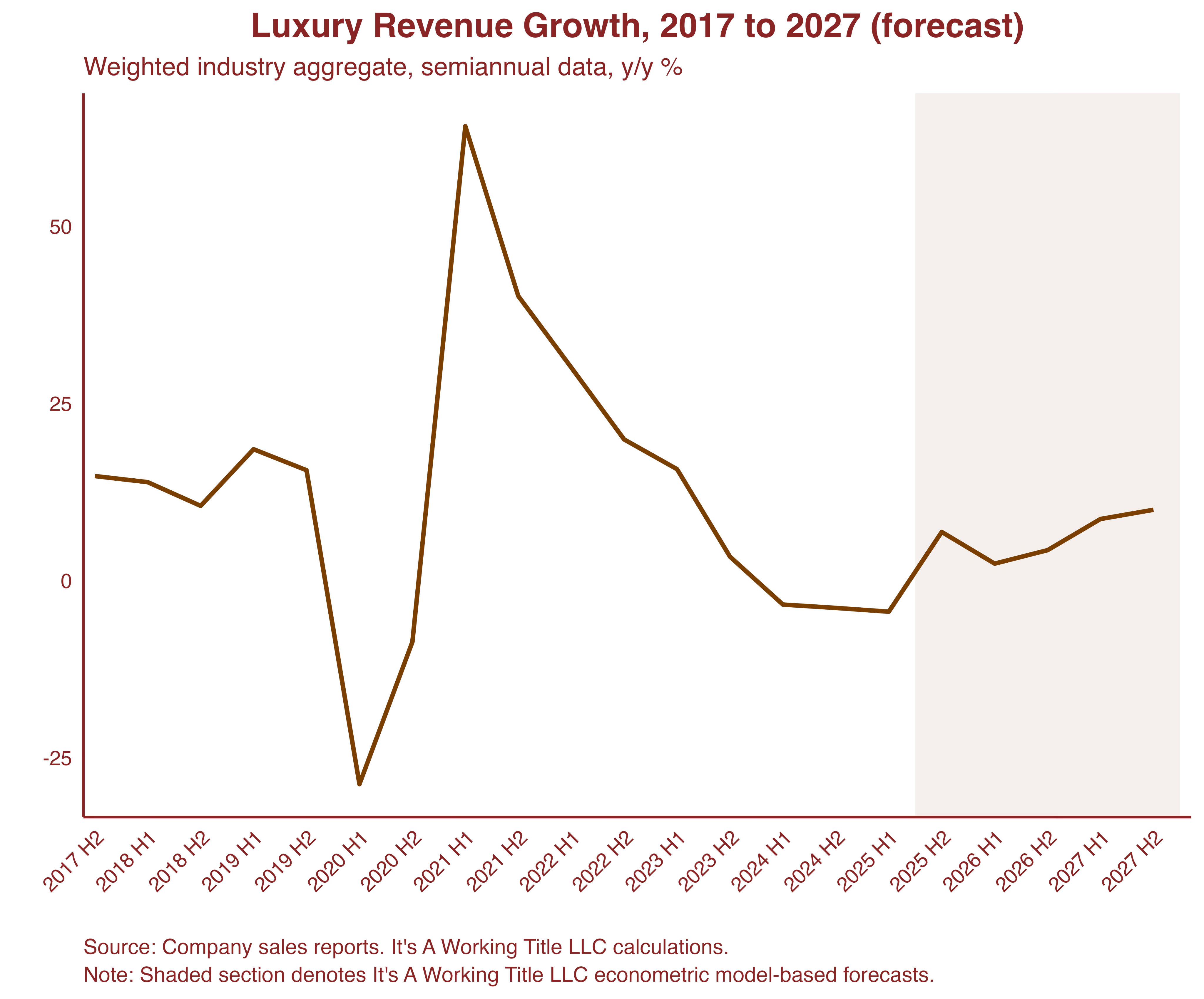
Yet, while most of the narrative around luxury for the past couple of years has been about a slowdown, the real story has been one of historically high differentiation. Some segments of the industry (for instance, beauty and wellness, travel and hospitality, and some automobiles) have exhibited resilience, while large segments of the fashion, leather goods, and wine and spirits businesses have struggled. But even among those luxury segments in recession, there has been a historically high degree of differentiated performance between winners and losers.
In fact, there has never been a period in recent history when performance by luxury brands has been so heterogeneous. To get a sense of the heightened level of dispersion in performance, we created a violin plot below, which illustrates how luxury firms’ revenue growth was distributed across the industry from 2017 to the latest results in 2025. The vertical axis shows revenue growth as a percentage for the luxury firms in our sample, while the width of the “violin” indicates the number of firms with results at that level. Taller, stretched violins indicate that firms’ performances were more scattered, while shorter, wider ones suggest they were more similar. The violin for the last two quarters is the longest over this nine-year period, and its thinness indicates relatively low clustering of similar results.
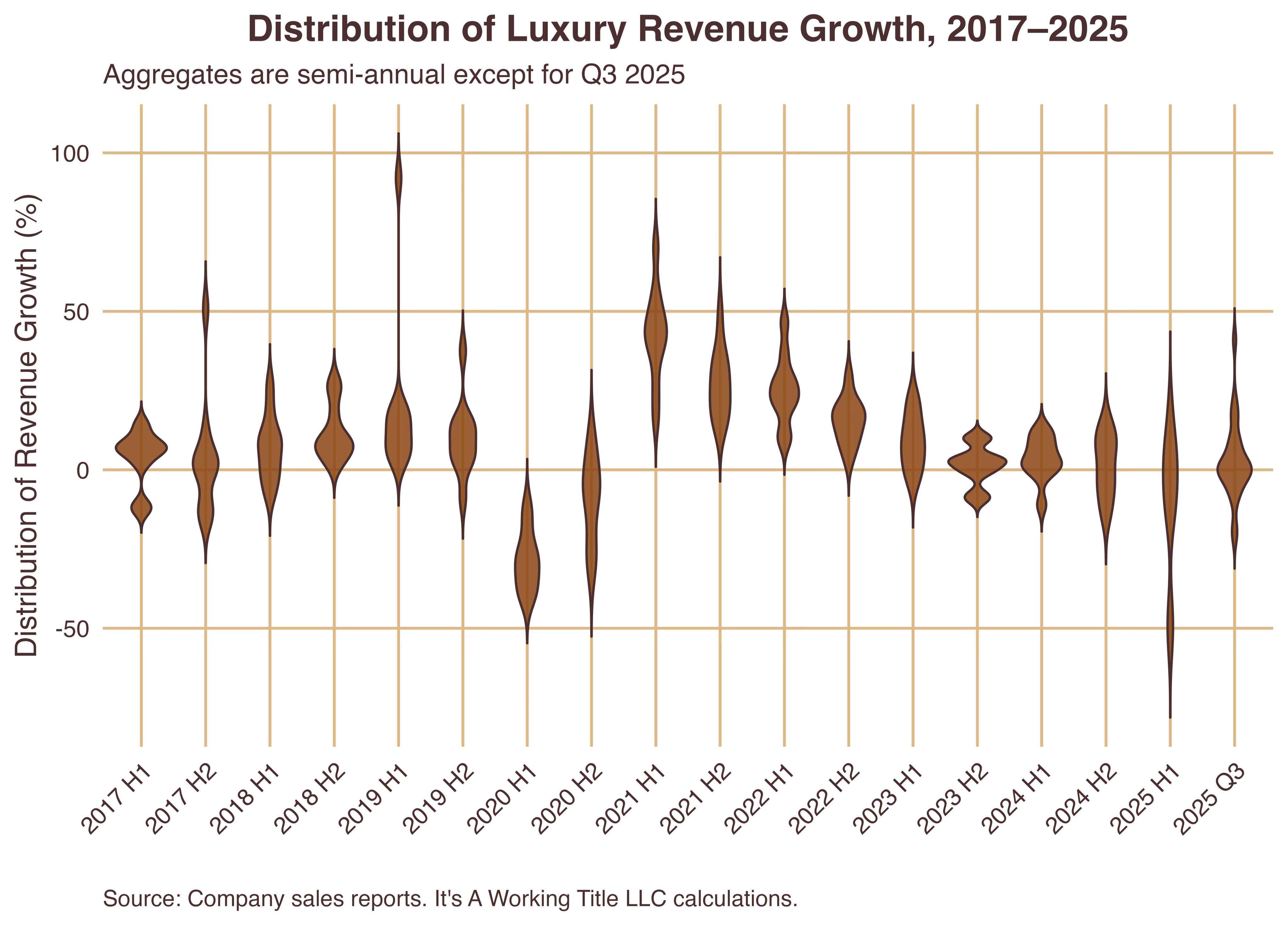
In fact since the pandemic, the volatility of luxury revenue growth has risen dramatically. Some standard measures of statistical variance point to this trend. The standard deviation of revenues, which shows the absolute spread of results, jumped from about 8–10 percentage points before 2019 to regularly above 20 and even into the 40s in recent periods. The coefficient of variation, which measures volatility relative to average growth, has spiked erratically since COVID—rising from around 0.7–1.0 before 2019 to levels above 2.0 and even near 4.0 in some recent half-years—showing that even strong years came with unstable performance. Meanwhile, the interquartile range—the spread between the middle 50 percent of firms—has widened from roughly 5–7 percentage points in the late 2010s to more than 12–13 percentage points after 2020, signalling that dispersion is no longer confined to a few outliers but now affects the core of the industry.
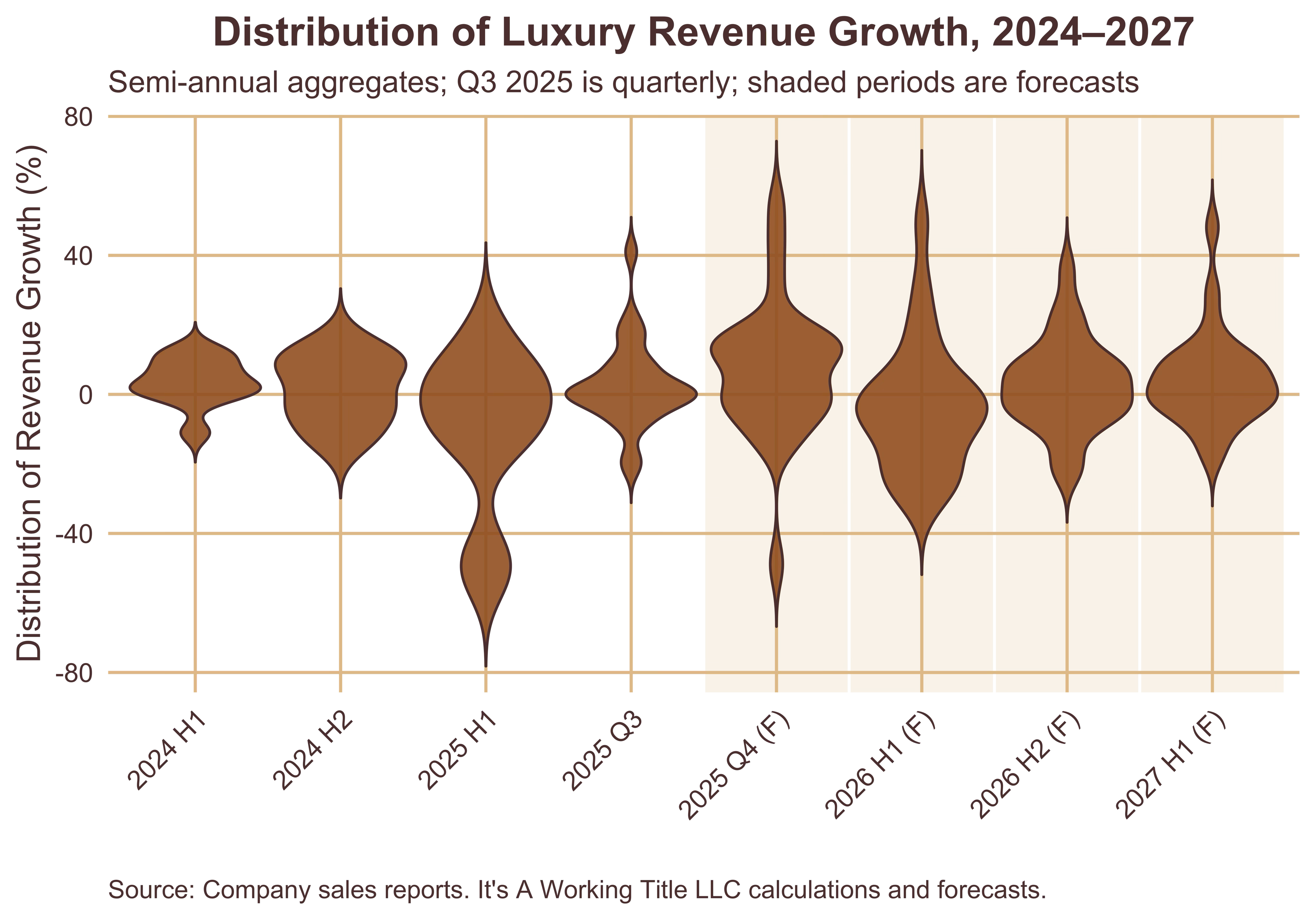
Our forecast is that differentiation will remain pronounced for the next two years, though it will come off its historic highs. The below figure exhibits our violin plots for 2024 and H1 2025 with forecasts for the fourth quarter of 2025 and semiannual forecasts for 2026 and 2027. We expect the standard deviation to decline from 21.9 in full-year 2025 to 17.4 this year and 13.1 next year. The coefficient of variation will decline from 2.3 in 2025 to 1.2 in 2027 while the interquartile range should drop from 26.1 to 14.6 during the same period. So we should start to see more cross-industry convergence as the broader industry emerges from recession, as we have predicted. But differentiation will remain above historical norms. What drives this unique period of differentiated performance across the luxury business?
The State of Luxury Brand Content and Storytelling in 2025
Content-wise, 2025 was a year of luxury noise and experimentation. Many luxury brands jumped on the AI bandwagon for marketing and social media content to varying degrees of success. Leaning into the trends for long-form content and TV-like episodic mini-narratives resulted in a lot of brands debuting on platforms like Substack and trying out new video content types on Instagram and TikTok.
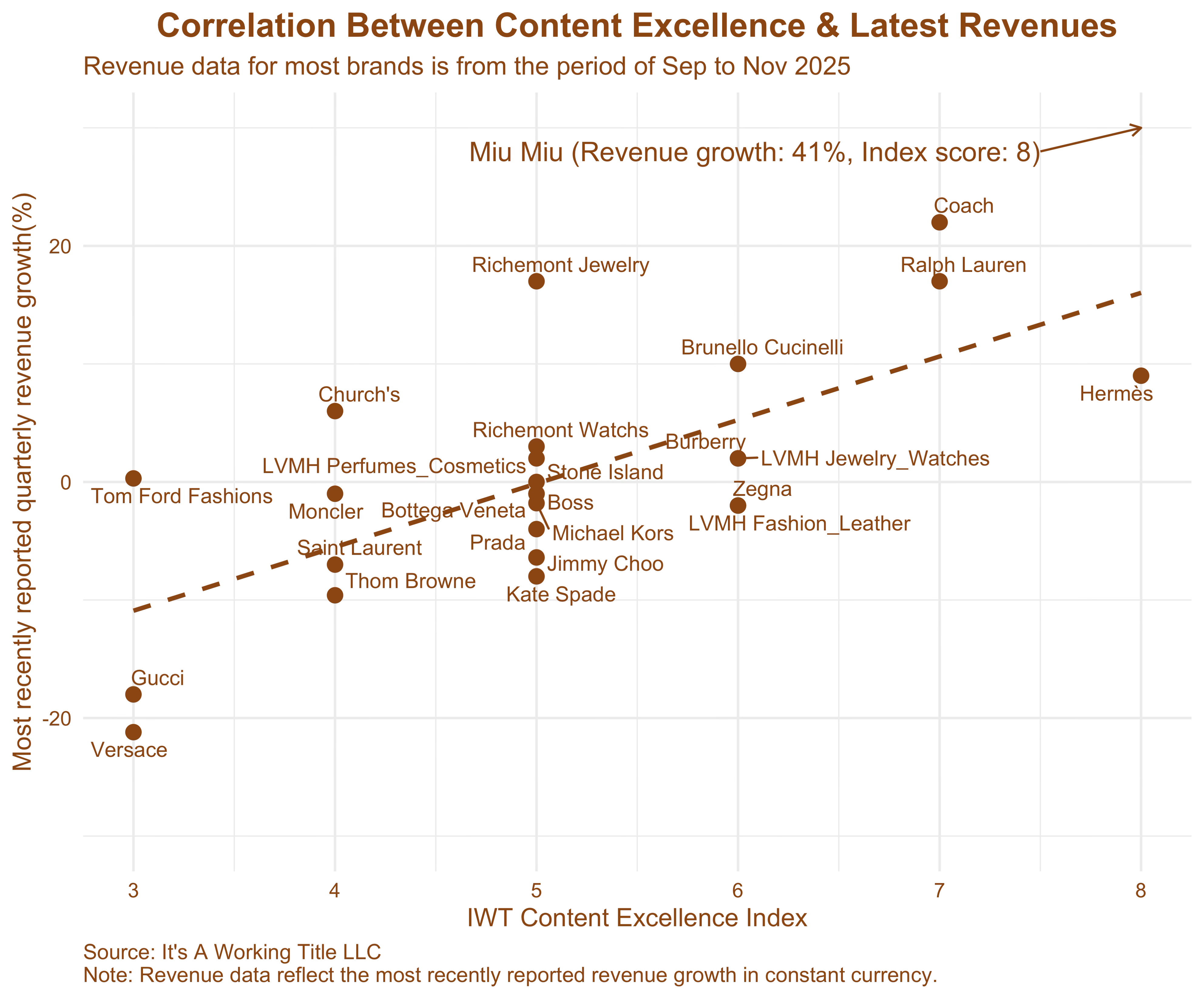
Like last year, our January 2026 It’s A Working Title Luxury Content Effectiveness Index (IWT CEI) points to a strong positive correlation between brand-level content quality and revenue growth. This is the second annual update to the index since publicly launching a portion of our quantitative content strategy and marketing diagnostics to the public in a January 2025 white paper. The public version of the broader diagnostics that we present to clients scores brand content quality excellence across three dimensions: (1) narrative marketing quality, (2) audience targeting/channel fit, and (3) content shoppability.
The chart highlights clear contrasts in brand performance: the brands that are the most rigorously consistent with content continue to outperform their competitors. Miu Miu remains the industry standout, combining one of the highest content excellence scores with revenue growth of about 41 percent, signalling strong alignment between digital strategy and commercial results. Hermes, Burberry, Ralph Lauren, and Coach also demonstrate both high index scores and solid positive growth, reinforcing their leadership positions.
At the end of the day, the luxury brands that topped our January 2026 IWT CEI did not shift their strategy as much in 2025 from 2024 as one might expect: The brands winning with content demonstrate a tight, differentiated narrative content strategy, show that they know their consumers inside and out, and execute on content in a way that identifiably reflects their core brand codes while being properly attenuated to the channel and cultural moment.
While this may sound hardly groundbreaking, consider: Hermès with its illustrations and playfulness; Miu Miu with its quirky yet feminine combo of short- and long-form storytelling; Burberry with its Brit-centric “Burberry Forward” strategy; Ralph Lauren with its deep Americana and, of course, the bear and his adventures; and Coach with its hyper-Gen-Z focus, Tabby bag, and endlessly creative IRL storytelling. In short, content consistency in 2025 for these CEI top performing brands came in the form of expected content formats, recognisable storytelling modes, and signature brand codes that showed up in every piece of content on every channel in creative but familiar ways.
Other interesting takeaways from 2026 IWT CEI top performers included a demonstrable seasonality to content platform functionality like Instagram shoppability: during major shopping moments, like the pre-holiday rush, luxury leans into more shoppable content, whereas immediately after big shopping moments, shoppability noticeably declines into a balance of creative, product, and celebrity-driven content. The extent to which luxury brands should pull from the DTC buy now-shop now playbook on channels like Instagram is up for debate and at best an individual brand choice. That said, brands have the power to curate how, when, and where consumers can engage in social shopping. But, judging from the sheer randomness of shoppability on many luxury brand social accounts, it is not clear that making a post shoppable is anything more than a random tactical decision rather than the result of planned strategic execution.
Indeed, middle and low performers on the IWT CEI this year showcased an almost overwhelming amount of content same-feelingness, inconsistency across platforms, lacklustre narrative, and copycat content marketing techniques, even among those that may seem more creative on the surface. And AI content experiments resulted in mixed reviews from consumers, even when overtly identified on the campaign level.
Mid-level performers–the likes of Zegna, Prada, Thom Browne, Jimmy Choo, LVMH Fashion & Leather, etc–are united by the presence of brand narrative but a lack of cohesion and actual differentiation in how these brand narratives get expressed through content on specific platforms. These brands, such as Zegna and Thom Browne, tend to excel at value-based or heritage storytelling on one channel, e.g. Instagram or the physical runway but struggle with the follow-through in other physical and digital contexts, which creates an inconsistent look and feel on the whole. This is particularly true for how these brands choose to show up in e-commerce, save for a handful of LVMH brands and Stone Island, which take a more distinctly narrative POV.
Low performers on this update of the IWT CEI, like Gucci and Versace, show a significant lack of consistency, a plethora of product and celebrity-driven campaigns with minimal or poorly-focused brand narrative, and content that is ill-targeted or overly generalised to specific channels and audiences.
On the whole, the January 2026 IWT CEI results make one point clear. Performance is no longer driven by platform tactics, creative novelty, or AI experimentation. It is driven by whether or not a brand operates from a coherent narrative system and a disciplined content architecture that governs how brand stories are designed, adapted, and executed across channels. The question for 2026 becomes not what new formats or technologies luxury should adopt, but whether brands are structurally prepared to build and sustain meaningful differentiation at scale.
The Differentiation Economy and the Future of Luxury Content in 2026
Online pundits keep observing that the luxury industry is in a crisis of its own making. Yet, as we have extensively written, the real story of luxury right now is one of differentiation: some brands continue to grow, while others are floundering. Luxury is not a monolith. It is a vast industry with highly idiosyncratic verticals that operate by their own rules, each serving distinct, though often overlapping audiences with unique needs, habits, and preferences. In a moment where many luxury fashion brands are struggling to distinguish themselves and attract the right shoppers under the weight of shifting post-pandemic consumer purchasing habits, other parts of the luxury industry, such as hospitality, which have more inherently service-focused, content-first business strategies, are reaping the benefits.
Does luxury need to be transformed? Perhaps yes, but it is already evolving as the business environment shifts and grows in real time. From now and into the future, the luxury brands that win with content will continue to win with consumers because we now live in a globally connected content-ocracy whether we like it or not. The key questions are no longer whether content matters, but how a brand stands out, what it stands for, and why it should last the test of time.
Content-wise, 2026 will be the year of simplicity and narrative streamlining. The brands winning with content will use AI more strategically and more quietly, largely behind the scenes in contexts with proven resonance for audiences. There is also a measurable seasonality to Instagram shoppability, and brands are increasingly able to flex a DTC mindset when it meaningfully serves campaign goals or long-term brand vision. There will be more play and less determinism in brand marketing content, less tactical copycatting of social trends, and more experimentation through the expression of brand codes in verisimilitudinous mini-narratives and episodic storytelling.
At the same time, brands are increasingly facing what we might call “content hysteresis”: the lingering effect of years of fragmented, campaign-led, trend-reactive content decisions that continue to shape brand perception, internal operations, and audience trust long after those tactics have stopped working. Just as in physical systems, hysteresis in content ecosystems means that change is not immediate, reversible, or frictionless. Brands cannot simply “decide” to be coherent, premium, or emotionally resonant; they must actively unwind the narrative debt embedded in their content architectures, workflows, and audience relationships. This makes consistency, simplicity, and structural coherence not only strategic virtues, but necessary corrective mechanisms.
Core brand strategy with streamlined, simple storytelling now matters more than ever, as strategists and brands alike need to stop treating luxury as a one-note category. Consistency has become the defining requirement for consumer-facing content, not because it is creatively limiting, but because system and structure allow brand storytelling to sing. Cutting through the noise of AI-generated content with something different but identifiably yours to say is critical to content in 2026 and beyond. When brands know how to package and distribute content correctly, their teams can spend more time on creative storytelling and less time worrying about where to cut a video for best effect or what a headline style should be.
So-called “boring” content types may ultimately be what lead brands to recognise the sheer power of holistic content strategy, particularly useful concepts such as structured, reusable content and repeatable templates. The brand differentiation and narrative consistency of top performers on the IWT CEI stems from brands creating and following a flexible, holistic content strategy backed by a defined narrative framework and organisationally appropriate operational infrastructure for content. This three-level approach makes brand content instantly recognisable, distinguishable from competitors, and easier for teams to create, publish, and scale, while also preparing content ecosystems for AI on both the front and back ends for content-specific use cases.
Building on our findings from the January 2026 IWT CEI, here are five predictions for luxury content in 2026:
1. Narrative coherence will become a measurable competitive advantage.
This year, brands with formal narrative frameworks will systematically outperform those without them across engagement, retention, and lifetime value metrics. In an AI-mediated content economy, coherence itself becomes an asset. Brands able to tell consistent stories across time, channels, and product lines will benefit from higher return on content investment, stronger recall, deeper emotional attachment, and more efficient reuse and scaling of content. Hospitality brands already operate this way, treating narrative continuity as infrastructure. Fashion and lifestyle brands that adopt similar narrative architectures will outperform those still operating in campaign silos.
2. Episodic storytelling will begin to replace campaign noise.
Luxury content will continue shifting away from loud, trend-chasing campaigns toward slow, episodic narrative ecosystems that function more like long-running brand series. In a global content ecosystem saturated with generative output, narrative consistency and world-building drive differentiation more than novelty. Brands will invest in creating serialised editorial universes, more holistic narrative experiences that more seamlessly connect IRL to digital, and evolving story worlds rather than one-off seasonal reinvention. Instead of endlessly rotating campaigns that are forgotten as quickly as they are posted, brands will start focusing on deeper, more aesthetic, and emotionally-driven storytelling to which consumers learn to recognise and return.
3. Content operations will more directly shape external brand perception.
How a brand runs content internally will increasingly determine how it is perceived externally. Operational incoherence produces narrative incoherence. Brands that invest in governance models, modular content systems, and repeatable narrative architectures will produce better, more distinctive storytelling. Brands without this level of operational infrastructure for content and content teams, platforms, and tools will continue to sound reactive, fragmented, and trend-dependent. Narrative distinction will be less a function of creative instinct and more the visible result of operational systemisation.
4. AI will become invisible infrastructure rather than a creative protagonist.
The luxury brands that begin to make headway with AI will use it quietly. AI will increasingly support modularisation, reuse, automation, formatting, distribution, and testing, while the storytelling layer will become slower, more protected. Structure will be more automated; but meaning will remain human. Brands that use AI as a creative driver will feel generic and disposable, while those that integrate AI into the backend of their content ecosystems will achieve consistency, scale, and cohesion without sacrificing narrative depth.
5. Narrative clarity and simplicity will become a signal of brand power.
As brand content demand and volume increases, content restraint will become even more of a core luxury signal. The most powerful brands in 2026 will communicate less but with greater narrative clarity, more emotional coherence. They will create less content with more connected narratives and fewer but more defined content types, while investing more deeply in consistent brand world building. In this context, simplicity will not mean minimalism or a lack of creative expressionism. Rather, it will signal a return to core brand codes and more differentiated brand identities.
In all, luxury does not need more content. It needs clearer stories, stronger systems, and more distinct brand worlds.
The brands that define luxury content in 2026 will not be the ones with the most viral posts or even the most technologically advanced. They will be the most consistent, the most narratively and emotionally legible, and the most structurally prepared. These brands will feel different because they are different, not necessarily in what they say, but in what they don’t and in how their entire content ecosystem is designed to make it impossible to forget who they are.