
Aman and the Case for Wellness as Narrative Strategy in Luxury Hospitality
FSW examines the state of wellness storytelling in luxury hospitality and considers what Aman reveals about narrative strategy as a competitive advantage.


“[T]he human desire to be taken care of never goes away.”
- Will Guidara, Unreasonable Hospitality
Insights
Every serious luxury hotel now has a wellness programme. Most have spas, sleep rituals, longevity menus, and in-house experts offering experiences like sound baths, champagne yoga, and mindfulness retreats. Yet, this is exactly why wellness by itself is not a major differentiator anymore.
The brands that approach wellness holistically as a core narrative expression of brand DNA across operations, storytelling, and experience design are in a league all their own. They are able to build the narrative and operational systems required to translate and refine that definition across every touchpoint.
The differentiated way that hospitality brands deliver wellness experiences is reflected in our IWT Global Luxury Hospitality Content Effectiveness Index (HCEI) results, which evaluate luxury hospitality brands across three core dimensions: digital experience, narrative marketing, and audience clarity. We put Aman at the top of the table.
What Aman demonstrates is that wellness, at the highest level, is not built by expanding programmes or adding layers of expertise. It is built by defining a point of view and ensuring that every element—environment, service, pacing, and offering—supports that definition over time.
In Simon Sinek’s introduction to Guidara’s Unreasonable Hospitality, he notes the book’s overriding thesis: “[G]reat service cannot exist without great leadership.” While the book covers a lot of ground, Guidara consistently argues that acts of service are inherently human and humane, improving business operations and outcomes while at the same time making experiences and, in turn, the world a better, kinder place.
The idea of acts of service may seem an unusual lens through which to look at the growing focus on wellness within hospitality. Yet, it is in fact critical to how luxury hospitality creates, frames, and builds its wellness narrative within its own ecosystem as well as to the global luxury market as a whole.
In a luxury context, “wellness” equates to a host of related and unrelated concepts that hospitality brands have to deal with, ranging from food, health, and beauty initiatives to deeper, more systematic experiential immersion. This complex web of definitions means that luxury hospitality brands need a defined vocabulary and strategy for how they talk about and approach wellness within their own brands; but also they need to invest in an overarching narrative strategy to drive consistency and clarity about wellness and wellness storytelling across brand content and communications, guest experience, and internal operations.
For a practical take, we explore these ideas through brief but focused case studies on the different ways in which Aman builds holistic, culturally contextualised worlds around wellness that seep through their guest experience and operations to varying degrees of success. This analysis draws on the inaugural It’s A Working Title Content Effectiveness Index (CEI) for hospitality, which evaluates luxury brands based on narrative coherence, experience design, and audience clarity.
The Deep Well of the Wellness Narrative
Every serious luxury hotel now has a wellness programme. Most have spas, sleep rituals, longevity menus, and in-house experts offering experiences like sound baths, champagne yoga, and mindfulness retreats. As an amenity category, wellness has more or less been won.
Unfortunately, this is exactly why wellness by itself is not a major differentiator anymore. One look at the data around the sheer explosion in the luxury wellness category reveals why. Wellness is no longer a poor cousin to luxury hospitality; it is one of its main engines of growth. According to the Global Wellness Institute, global wellness tourism alone now represents $651 billion in annual spend with projected growth of 16.6 percent annually through 2027, making it one of the fastest-growing sectors within the global wellness economy.
The difference maker now is not whether a luxury hospitality brand offers wellness, but actually what it means by the term in the first place. Across luxury hospitality, wellness operates as a flexible and often ill-defined concept. For some brands, it signals personal optimisation: longevity, performance, and measurable outcomes. For others, it centres on physical and psycho-social restoration: retreat, recalibration, stillness, and mindful community building. Then for other brands, it becomes full-on experiential immersion, with wellbeing intricately tied to place and environment or to education, with guests being given life frameworks to carry with them home beyond their stay.
Most hospitality brands conceptualise wellness in a way that covers several of these definitions at once. The result is a vague, over-generalised notion of wellness that often contributes to a proliferation of disconnected initiatives without a clear narrative point of view.
The brands that approach wellness holistically as a core narrative expression of brand DNA across operations, storytelling, and experience design are in a league all their own. They are not only defining what wellness means within their world but also what it does not mean. From there, they are able to build the narrative and operational systems required to translate and refine that definition across every touchpoint.
It is in this strategic narrative approach that wellness shifts from amenity to a narrative brand system. And it is also where acts of service move from a function of operations to a central mechanism through which wellness is delivered and experienced.
Acts of Service as the Operating Logic of Wellness
If acts of service shape how wellness is experienced, the question is how it shows up in practice. This is where Guidara’s framing of hospitality as a series of acts of service becomes useful, not because it elevates service as performance, but because it treats it as a way of thinking. Acts of service are about recognising what a guest needs, usually before they articulate it, and delivering it in a way that feels natural rather than orchestrated.
In a wellness context, most hospitality brands focus on what they offer—treatments, programmes, experts, and experiences—rather than how those offerings are actually experienced and what they signal about the brand as a whole. From a guest perspective, however, wellness is rarely defined by a single offering. It is defined by how the entire stay feels and how much friction has been removed along the way.
Two hotels may offer similar spa menus or longevity programmes, but the experience can feel entirely different depending on how those elements are organised. In one case, the stay feels like a connected whole. In another, it feels like a series of well-designed but separate offerings.
This divergence in how hospitality brands deliver wellness experiences is reflected in our IWT Global Luxury Hospitality Content Effectiveness Index (HCEI) results, which evaluate luxury hospitality brands across three core dimensions: digital experience, narrative marketing, and audience clarity.
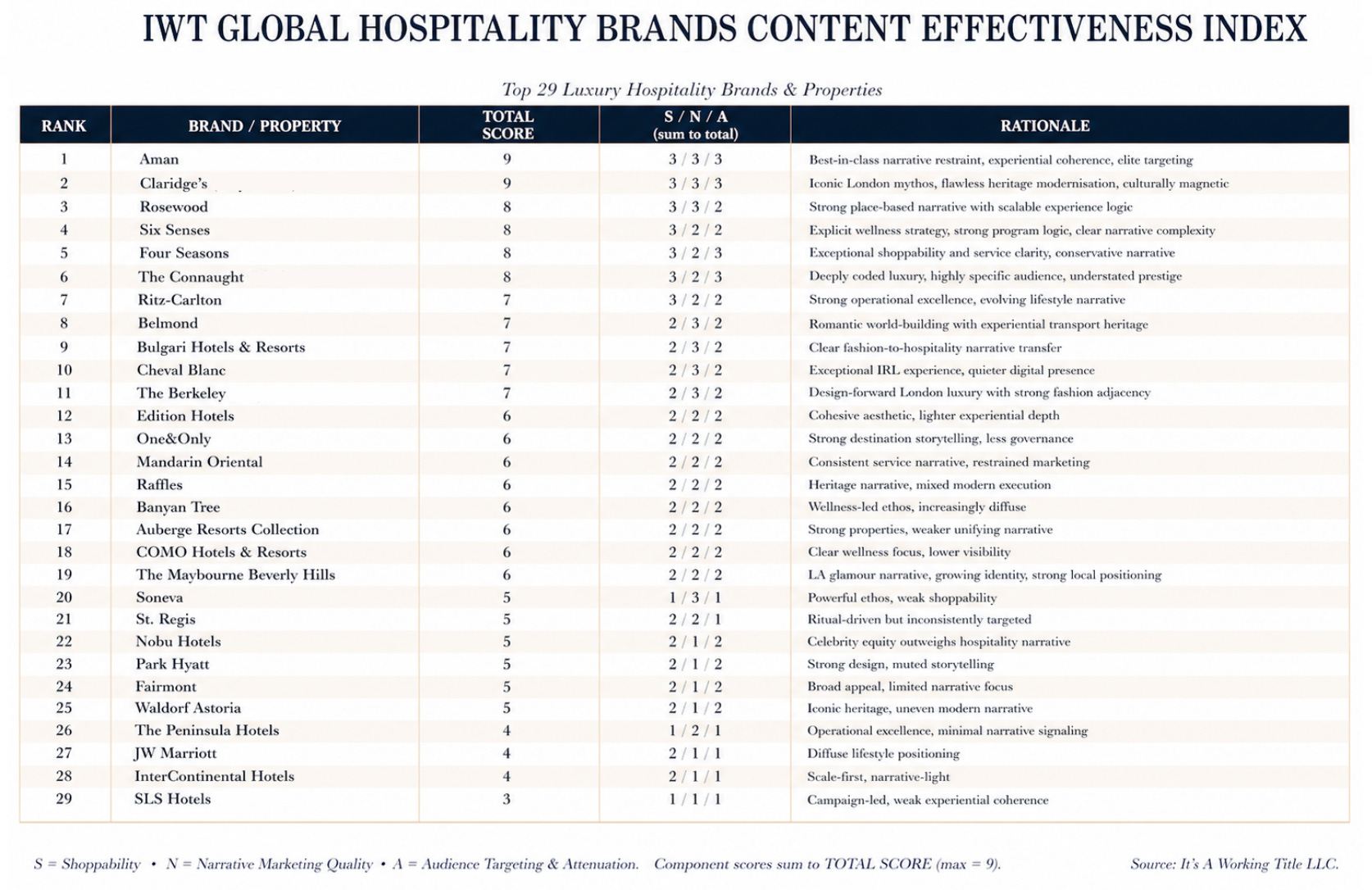
What the index makes visible is not simply how brands approach wellness, but how they structure experience more broadly. Performance does not track with the volume of offerings, whether in wellness, dining, programming, or service, but with how clearly those elements are defined and how consistently they are carried across the guest journey.
High-performing brands are clear about what they stand for and carry that through the entire experience. This is often visible in how a property is designed, how staff interact with guests, how programmes are framed, and how the brand communicates across its website and booking journey. These elements reinforce one another, so the stay feels consistent from start to finish.
Lower-performing brands tend to take a more additive approach. They introduce new programmes, expand wellness offerings, and layer in expertise, but without fully connecting those elements back to a clear point of view. The result is an experience that looks comprehensive, but feels uneven in practice—shifting between different tones, priorities, and ways of engaging the guest.
Wellness makes this difference easy to spot because it cuts across so many parts of the experience. It shows up in the spa, in-room amenities, food and beverage, programming, and increasingly in how the brand presents itself digitally. In top-performing brands on the HCEI, these elements are aligned. A treatment, a menu, and a piece of content all reflect the same underlying idea of what wellness means. In lower-performing brands, all these elements can feel loosely related, well-executed on their own, but not clearly part of the same experience.
Aman offers a clear example of how this works in practice, approaching wellness with a level of cohesion and control that sets it apart from its peers.
Aman: A System of Care
Aman did not arrive at its approach to wellness by simply expanding into the category. From its founding in 1988 by Adrian Zecha, the brand was built around a different premise: that the hotel experience itself should function as a form of retreat. Its early properties such as Amanpuri in Phuket established a model centred on space, privacy, and a deep sense of place, with architecture, service, and experience designed and paced to shape and control how a guest feels upon arrival.
In this context, wellness at Aman was never introduced as a separate offering. It emerged as a natural extension of the brand’s foundational vision. As the brand expanded, Aman continued to develop spas, retreats, and more formalised programmes. But, all of these were layered into an already coherent experience rather than just added to it as yet another amentiy.
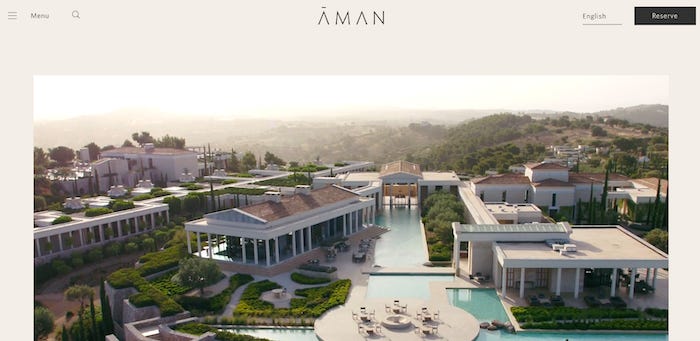
On the Aman website, this approach remains visible. Wellness is present but not over-articulated. Guests are offered spa houses, curated retreats, and tailored programmes. But, these are framed as part of a broader environment of sanctuary rather than as discrete, outcome-driven interventions. This same philosophy has been carried into the brand’s digital experience, developed in partnership with Matter Of Form, where clarity, restraint, and continuity shape how guests engage with the brand before they arrive. The emphasis within the narrative of wellness remains on the overall experience rather than on individual components.
This holistic wellness positioning carries through to the Aman in-person stay. The experience is designed to feel continuous, with measured and unobtrusive staff interactions and intuitive movement through the property. There is no clear distinction between “wellness activities” and the rest of the stay; everything has a sinuous look and feel, operating at the same level of calm, control, and attention.
At Aman, acts of service are what make this possible. Service is used to integrate the experience rather than to punctuate it, with needs anticipated, timing carefully managed, and transitions smoothed out before they are noticed. The guest is not asked to make frequent decisions or engage with multiple frameworks, allowing the experience to unfold without interruption.
In practice, this creates a genuinely systemic form of wellness:
Wellness is embedded across the entire stay. At properties such as Amangiri, the physical environment—open desert landscapes, minimal architecture, and controlled sightlines—works in tandem with spa programming and service pacing to create a continuous sense of stillness rather than a sequence of activities
Programmes support the system, rather than define it. Offerings such as the Aman New York Spa Houses or multi-day retreats are expansive, but they are framed as extensions of the environment, with no expectation that the guest must complete a programme or achieve a defined outcome
Service connects every touchpoint. Staff interactions are intentionally minimal and precisely timed, from arrival rituals to in-room dining and spa transitions, creating continuity without requiring instruction or intervention
The guest experiences coherence without needing explanation. There is no initial screening, prescribed pathway, or structured wellness plan; the experience unfolds without requiring the guest to interpret or assemble it
This consistency is not incidental. It is the result of a deliberate approach that begins with a clear definition of what the experience should feel like and extends through every operational and design decision. Aman’s performance at the top of the index is therefore not driven by the visibility of its wellness offering, but by how completely that offering has been absorbed into the structure of the experience itself.
What Aman demonstrates is that wellness, at the highest level, is not built by expanding programmes or adding layers of expertise. It is built by defining a point of view and ensuring that every element—environment, service, pacing, and offering—supports that definition over time.
In this model, acts of service are not a supporting layer but the mechanism that holds the experience together. They connect spaces, shape transitions, and remove the need for the guest to navigate the stay as a series of choices, allowing the experience to remain continuous from arrival to departure.
The result is a form of wellness that does not need to be explained in order to be understood, because it is coherent in how it is delivered. It is holistic not as a claim, but as a consequence of how the experience has been built.
Wellness as Narrative System
What Aman makes clear is that the question for luxury hospitality is no longer whether to invest in wellness. It is how to define it and how to carry that definition consistently and holistically throughout the ecperience, attenuated to every touchpoint.
Across the global hosptiality market, there is no shortage of high-quality wellness experiences: expansive spas, expert-led programmes, thoughtful design, and attentive service. Yet, at many luxury hotels, these elements often sit alongside one another rather than working together, resulting in experiences that feel considered in parts but unresolved as a whole.
Aman offers a different model. Wellness is not positioned as a category within the experience, nor even as a set of programmes to be navigated. It is embedded from the outset and reinforced through acts of service that connect each moment to the next, shaping how the guest moves through the space, how time is structured, and how the experience unfolds.
In this sense, wellness functions not as an offering, but as a narrative system. It defines how the experience is organised and how meaning is carried across it.
The implication for luxury hospitality brands is straightforward. Differentiation will not come from expanding the scope of wellness or increasing the number of programmes. It will come from making deliberate choices about what wellness means within the brand and building the experience to hold that definition with precision over time.